
Life Saving Wonder Drug: the story of Insulin
Today, being 14th November is special for more than one reason.
As we all are aware, we celebrate ‘Children’s Day’ on 14th November, with effect from 1954.This day also happens to be the birth day of India’s first Prime Minister, Pundit Jawaharlal Nehru, who was born on 14th November 1889.
Another important celebration on this day is World Diabetes Day. In order to emphasise the awareness of the deadly disease of Diabetes, the United Nations Organisation, announced this day, 14th November, to be observed as World Diabetes Day, from the year, 2006 onwards.
But, what is the reason for celebrating the World Diabetes Day on 14th November is quite interesting. Let us discuss that little later.
Diabetes is an age old, chronic, and metabolic disease. It is one of the causes of blindness, apart from kidney failures, heart attacks, and lower limb amputations. We understand that diabetes has been diagnosed as early as 1552 BCE in Egypt, and in India, as early as 5th century BCE, by the then physicians like Shushrutha and Charaka. They diagnosed diabetes as “madhumeha”, meaning ‘honey urine’. As per Atharva Veda, diabetes like conditions existed even in ancient days. According to a World Bank study, about 422 million people worldwide have diabetes and 1.5 million deaths are directly attributed to diabetes each year. In 2019 alone, about 2 million deaths had happened due to Diabetes. Also, the intensity of this disease is increasing year by year. According to Wikipedia, in India alone, about 7 lakh people had died during year 2020, due to diabetes.
There are four types of diabetes. Ttype1, where the pancreas produces little or no insulin; Type2, where the body does not produce enough insulin or it resists insulin; Gestational diabetes (diabetes during pregnancy) and Pre-diabetes, in which the blood glucose level is high but not enough to classify as diabetes (type2).
One of the major worrying aspects of the diabetes disease is that it affects vision loss, such as diabetic Retinopathy, Macular edema, cataract, and Glaucoma, in large scale, leading to complete blindness and even deaths sometimes.
The Dawn of Wonder Drug, Insulin: Till the dawn of 20th century, diabetes was a dreadful disease causing deaths in many instances. This era was described as ‘Frustration Era”. Scientists spent sleepless nights to find a suitable remedy. In 1889, two German scientists, Osar Minkowski and Joseph von Mering, observed that dogs, when their pancreatic gland was removed, developed diabetes and then died. This helped them to zero in on the substance produced by pancreas. In 1916, Sir Edward Albert Sharpey -Schafer, identified that the pancreatic glands are secreting a substance capable of controlling glucose metabolism. He termed it, as insula as pancreatic gland resemble an island.
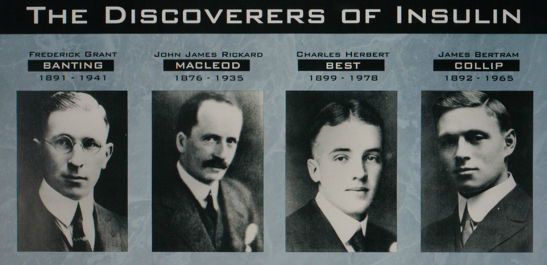
The Great Invention: It was in 1921, two Canadians, Frederick Banting, a surgeon, and Charles Best, a research student, successfully extracted Insulin from a dog’s pancreas and made a diabetic dog live for another 70 days. These two scientists joining hands with another two more, namely John Macleod, a professor at Toronto University, and J.B.Collip, a biochemist, who was a specialist in purifying the Insulin, developed more refined form of insulin from cattle. It worked miraculously on Leonard Thomson, a 14 year old boy and his blood sugar level came down to normal on successful treatment with the insulin.
In January1923, the U.S. Patents for insulin was awarded. On October, 25th of the same year, Banting and Macleod were awarded the Nobel Prize for medicine, which they shared with their other two colleagues.
Further Advancements: However the insulin extracted from pigs and cattle, though used for a long time to save the life of diabetes patients, caused some allergic reactions in patients sometimes even resulting in deaths. Therefore scientists continued their research further. In 1978, they successfully produced human insulin using E.Coli bacteria. Finally in 1982, biosynthetic human insulin was made available for commercial use, under the brand name, ’Humulin’, ‘Humalog’ etc.
Delivery Methods of Insulin: In order to keep the blood glucose levels in a desired range, it is essential that the required quantum of insulin is administered on a daily basis to those diagnosed. The preferred route of insulin administration is subcutaneous insulin injections. This was administered by vials, syringe, injecting pen, etc. However under this method, some problems, such as pain, needle phobia, etc. were encountered. Therefore alternatives under minimal invasive and non invasive methods are being examined. Some of these are oral, buccal, nasal, peritoneal (tissue lining abdominal cavity) and transdermal (through Skin) methods.
Now, let us solve the suspense, shrouding around selection of 14th November, as the ‘World Diabetes Day’? It is because of The International Diabetic Federation in consultation with WHO decided that in memory of the great scientist Sir Frederick Banting, who discovered insulin, his birth day, the 14th November, shall be celebrated as World Diabetes Day since its launch in 2006.
Our Obligations: Doctors have observed that the incidence of Diabetes, is more prevalent in India than other European countries. They have also pointed out that the occurrence of diabetes is more among the rice eating population. Therefore, on this day, let us pledge to eradicate completely the menace of diabetes, by limiting our intake of Carbohydrate and fat content in our food and substituting with enough proteins, complemented by regular exercises.
Gurumoorthy Iyer